Memoirs of Elizabeth Collins
Available NowA gathered memoir of an American Quaker minister — devotional, letter-rich, and quietly searching.
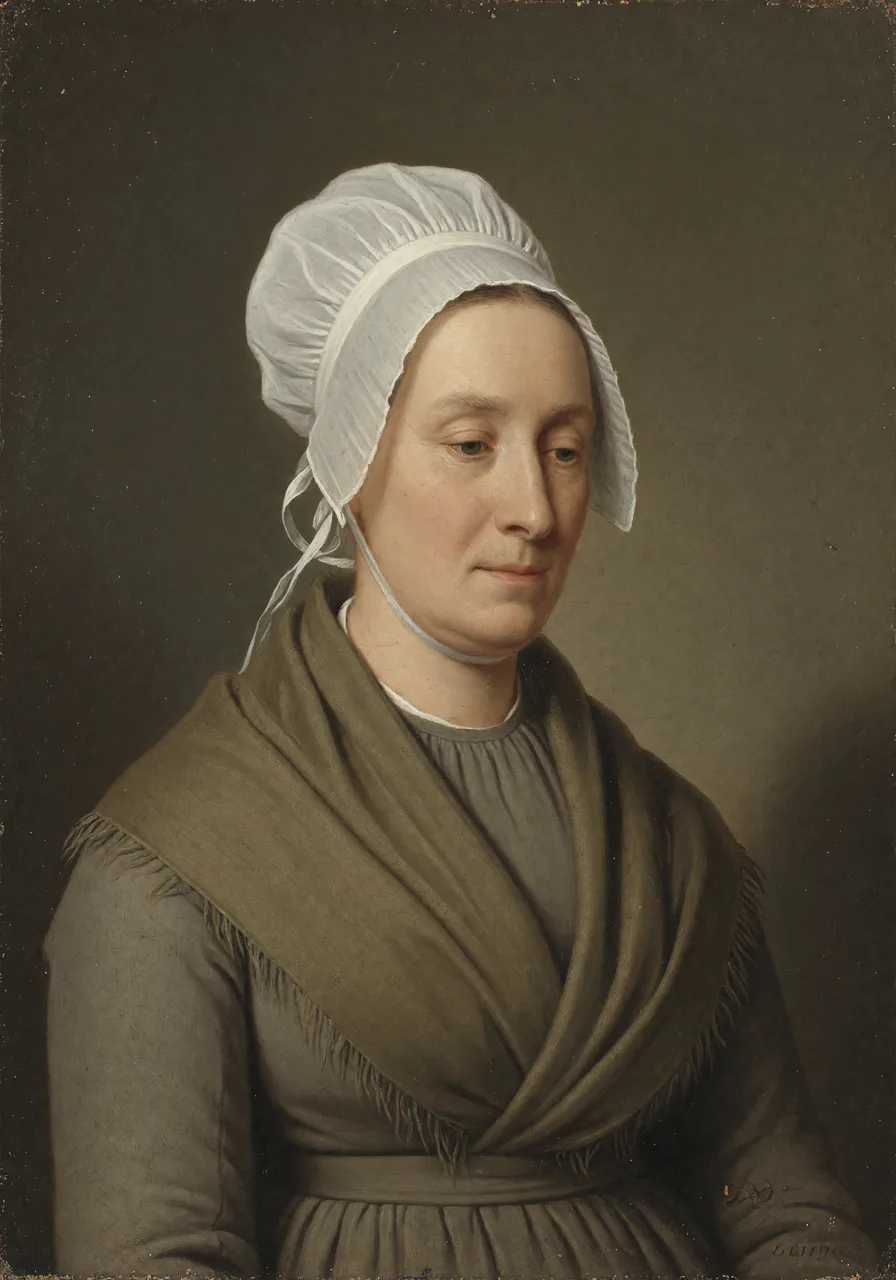
American Friend and minister of quiet devotion
Elizabeth Collins was born Elizabeth Ballinger on the fourth of the First month, 1755, in Burlington County, New Jersey — a weakly child who was not expected to live. She was put out as an apprentice while still young, married John Mason at eighteen, and was a widow about four years later, before she had reached twenty-five. In 1778 she married Job Collins and settled at Upper Evesham, New Jersey, where she remained for the rest of her life.
She began to appear in the ministry around the age of twenty-four and was in due course recorded a minister by her Monthly Meeting. What followed was more than fifty years of service among Friends. Her travels were not the transatlantic journeys of the great eighteenth-century itinerants but the steady, repeated work of a regional minister: long rides through the Jerseys, southward into Virginia as far as Hopewell, across to New York and Long Island, and again and again down to Cape May. She records the meetings that opened and the meetings that did not, and she does not pretend the second kind were rare.
She was in Philadelphia during the yellow fever epidemic of 1793. She lived through a run of bereavements severe enough that she sits down at one point in the narrative deliberately to count her mercies — a passage that tells the reader, without any complaint being entered, exactly how much she had lost. She lived long enough to see the Hicksite Separation of 1827–28 divide the Society she had served for half a century, and she died in 1831.
Her Memoirs were first printed in 1833, drawn chiefly from her own journal and from letters written to and by her. A large part of the text is her first-person account, plain and unliterary; around it are gathered correspondence and the Testimony of Upper Evesham Monthly Meeting concerning her, which closes the volume. The book is quieter than the celebrated travelling journals of its century, and its value lies in that quietness: it is the record of an American woman who was given ordinary work and did it for fifty years without stopping, through epidemic, grief, and finally schism.
A gathered memoir of an American Quaker minister — devotional, letter-rich, and quietly searching.