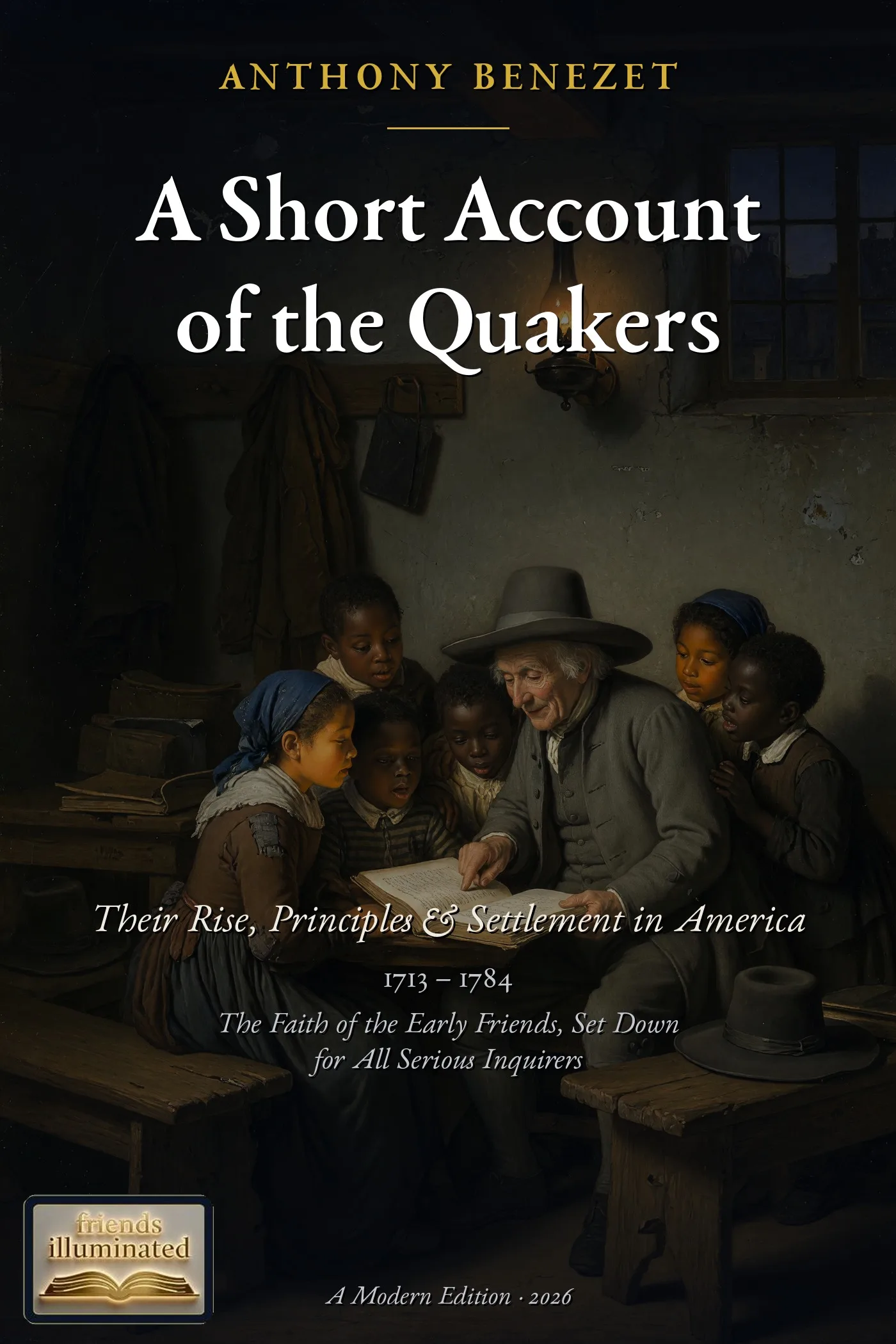
A Short Account of the People Called Quakers
Anthony Benezet (1713–1784) — the Huguenot-born Philadelphia schoolmaster and pioneering abolitionist — sets down a plain, sympathetic account of the people called Quakers: their rise in England, their settlement in Pennsylvania under William Penn, and the principles of worship, peace, plainness, and conscience by which they lived. A modern English edition with linked scripture and historical references.
- A plain introduction to the Quakers: their rise, principles, and settlement in America
- Includes the peace testimony, the witness against slavery, and Penn's Charter of Privileges
- EPUB format
This edition
Read itE-book · EPUB
- Time to read48 minutes
- Length11,506 words
- Files1 EPUB, DRM-free
How we get 48 minutes
This figure is here so you can compare one book against another. Every title on the site is timed from its own word count at the same reading speed — nothing is adjusted book by book — so if this edition says 48 minutes and another says half that, the second one really is about half the reading. It is a measure of size, in the way a page count is. Your own pace is your own: at the speeds typical adult readers actually manage, this edition runs anywhere from 38 minutes to 1.1 hours.
What is in this edition
| Modernized text | 7,626 words |
|---|---|
| Introduction, chapter summaries and notes written for this edition | 3,880 words |
| Total | 11,506 words |
The introduction, the chapter summaries and the notes on people, places and unfamiliar terms were written for this edition. They are 3,880 of the 11,506 words above, and they are part of what you are buying.
Counted from the text of the EPUB you receive. Navigation, the title page, the table of contents and the licence page are excluded — they are packaging, not reading.
The reading rate
238 words per minute, for adult silent reading of non-fiction, applied unchanged to every title on the site. We did not pick the number; it is the pooled result of a published meta-analysis. Nothing is adjusted book by book — that consistency is what makes two of these figures worth comparing.
Brysbaert, M. (2019). How many words do we read per minute? A review and meta-analysis of reading rate. Journal of Memory and Language, 109, 104047. doi:10.1016/j.jml.2019.104047
190 studies, 18,573 participants.
The same paper puts most adult readers between 175 and
300 words per minute, and those two speeds give the
38 minutes and 1.1 hours above.
Because time is words divided by speed, an even range of speeds produces an
uneven range of times, so 48 minutes sits nearer the fast end of that
range than the middle of it.
If it were a paperback
Roughly 33–46 pages.
Words per printed page is a typesetting convention, not a measurement — it moves with trim size, type size and leading. The range above assumes 250–350 words a page. Friends Illuminated publishes no print edition of this book; the figure is here only because pages are a more familiar size than words.
- Secure checkout by Stripe
- Instant download
- 7-day money-back guarantee
About This Edition
Anthony Benezet (1713–1784) was one of the most quietly influential Friends of the eighteenth century. Born into a Huguenot family that had fled France for its faith, he came at last to Philadelphia, joined the Society of Friends, and gave his life to teaching — founding a school for the poor, another for girls, and one of the first schools in America for Black children, whom he taught with his own hands. Out of that long labor of conscience came a stream of writings against the slave trade that reached Granville Sharp, John Wesley, and Thomas Clarkson, and helped set the abolitionist cause in motion on both sides of the Atlantic. This little book shows the ground on which he stood.
A Short Account of the People Called Quakers is exactly what its title promises: a clear, unpolemical introduction to the Friends, written by one of their own for readers who knew them only by rumor. Benezet traces the rise of the movement in England amid the confusions of the seventeenth century, the sufferings of its first preachers, and the settlement of Friends in America — reproducing the heart of William Penn’s Charter of Privileges of 1701, with its solemn and unalterable guarantee of liberty of conscience. He explains in plain terms the Quaker manner of worship and ministry, the testimony against war, the refusal of oaths and of the outward sacraments, and the discipline by which the meetings ordered their common life.
Running through the whole is Benezet’s own deepest concern. The account turns, near its close, to the keeping of slaves as a thing utterly at odds with the principles it has described — the same principles of the light of God in every man, and of love to all mankind, that had drawn Benezet himself into the Society. This Friends Illuminated edition presents his text in lightly modernized English, with the plain speech of Friends preserved where he used it, and scripture and historical references linked throughout.