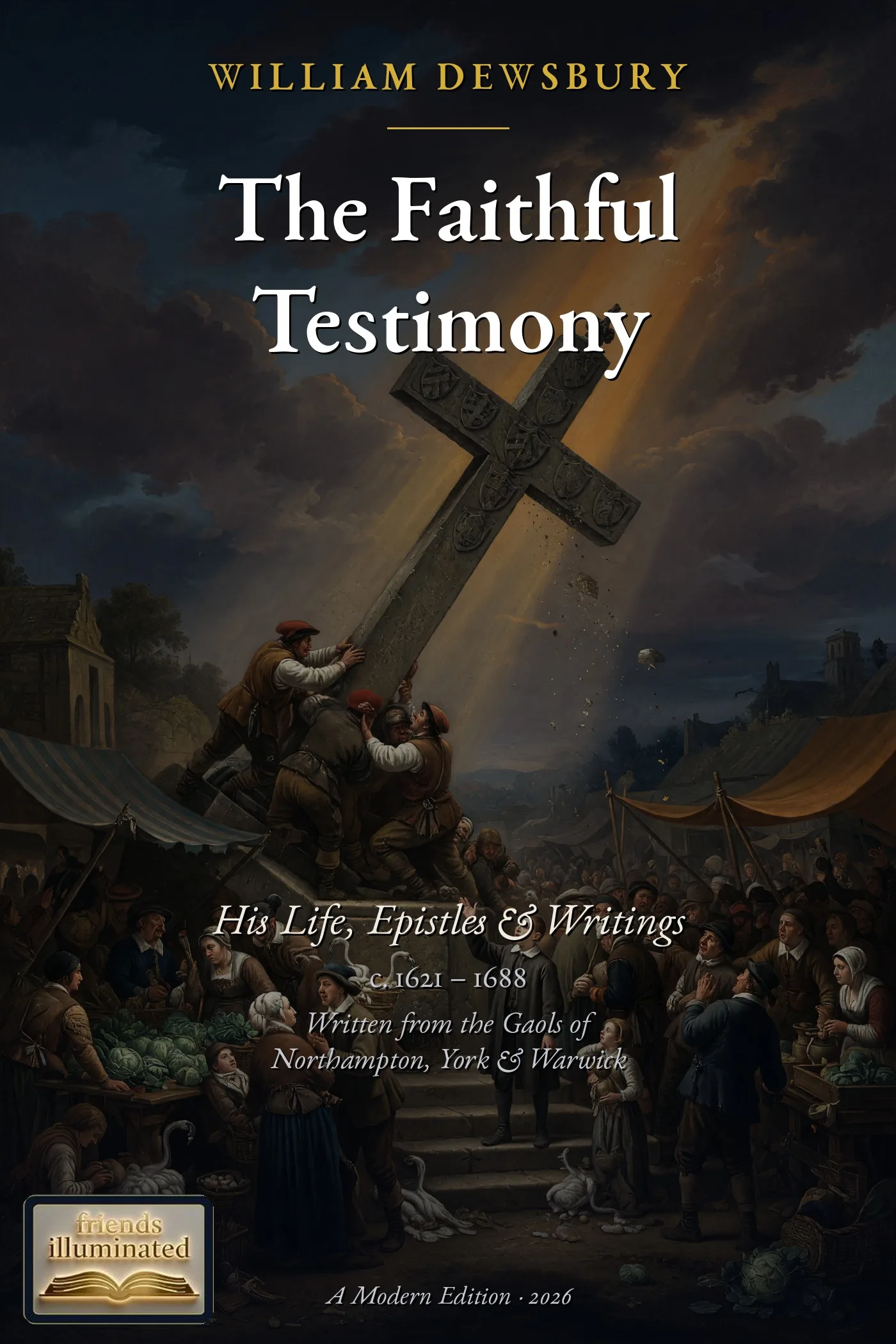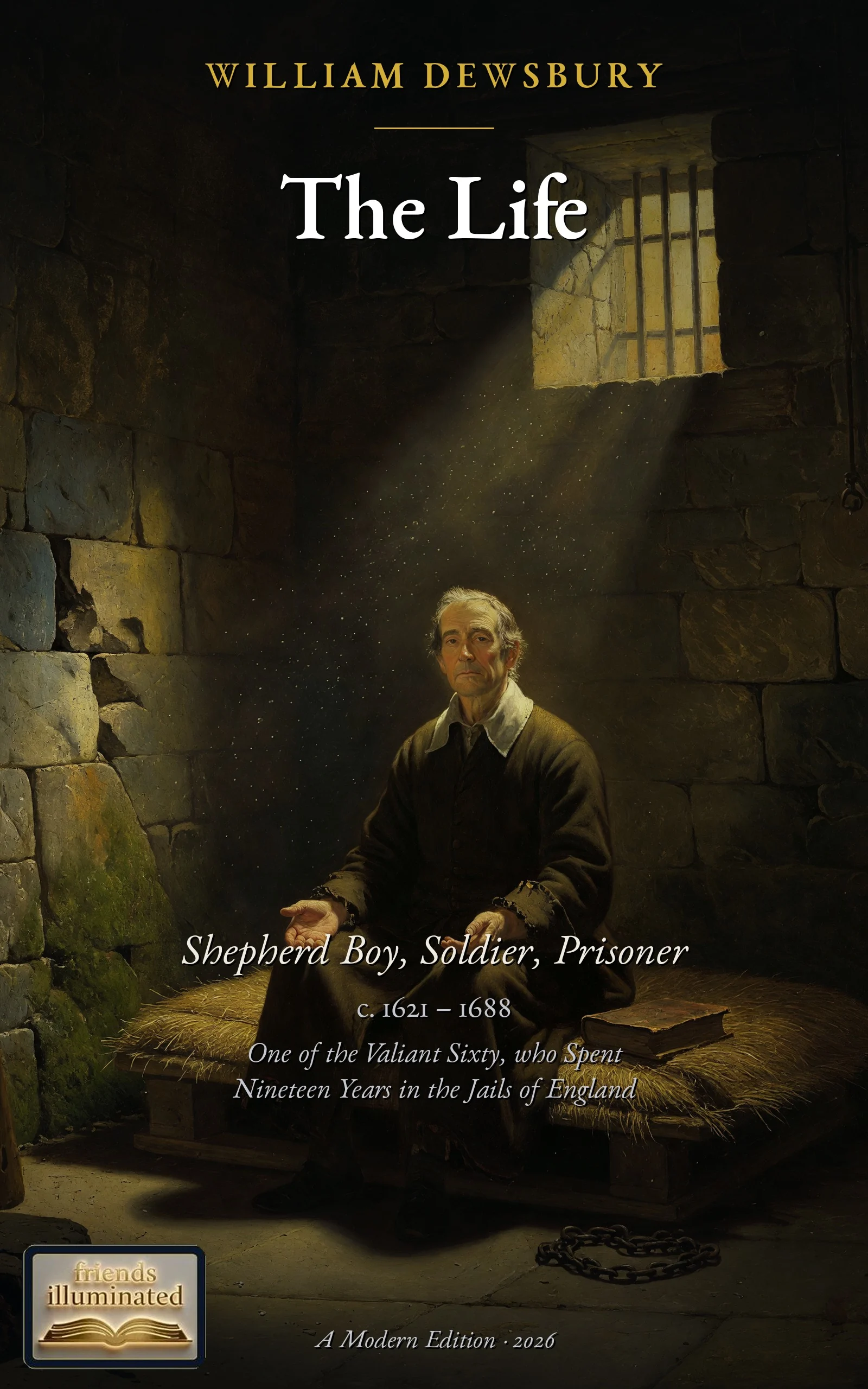
The Life of William Dewsbury
William Dewsbury (c. 1621–1688) — shepherd boy, weaver's apprentice, Parliament soldier, and one of the first travelling ministers of the people called Quakers — in the memoir assembled by Edward Smith for The Friends' Library, together with his letters, epistles, and courtroom answers. The story runs from a fatherless childhood in the East Riding to the Restoration jails, where he spent close to nineteen years, and to his death in London in 1688, a few months before the Toleration Act made his life's work legal. A modern English edition with linked scripture and historical references.
- The Friends' Library memoir assembled by Edward Smith, following Dewsbury from shepherd boy and Parliament soldier to one of the Valiant Sixty
- His letters, epistles, and courtroom answers — including the 1655 examination at Northampton before Matthew Hale — with close to nineteen years of imprisonment in his own words
- EPUB format
This edition
Read itE-book · EPUB
- Time to read7.1 hours
- Length100,912 words
- Files1 EPUB, DRM-free
How we get 7.1 hours
This figure is here so you can compare one book against another. Every title on the site is timed from its own word count at the same reading speed — nothing is adjusted book by book — so if this edition says 7.1 hours and another says half that, the second one really is about half the reading. It is a measure of size, in the way a page count is. Your own pace is your own: at the speeds typical adult readers actually manage, this edition runs anywhere from 5.6 hours to 9.6 hours.
What is in this edition
| Modernized text | 92,697 words |
|---|---|
| Introduction, chapter summaries and notes written for this edition | 8,215 words |
| Total | 100,912 words |
The introduction, the chapter summaries and the notes on people, places and unfamiliar terms were written for this edition. They are 8,215 of the 100,912 words above, and they are part of what you are buying.
Counted from the text of the EPUB you receive. Navigation, the title page, the table of contents and the licence page are excluded — they are packaging, not reading.
The reading rate
238 words per minute, for adult silent reading of non-fiction, applied unchanged to every title on the site. We did not pick the number; it is the pooled result of a published meta-analysis. Nothing is adjusted book by book — that consistency is what makes two of these figures worth comparing.
Brysbaert, M. (2019). How many words do we read per minute? A review and meta-analysis of reading rate. Journal of Memory and Language, 109, 104047. doi:10.1016/j.jml.2019.104047
190 studies, 18,573 participants.
The same paper puts most adult readers between 175 and
300 words per minute, and those two speeds give the
5.6 hours and 9.6 hours above.
Because time is words divided by speed, an even range of speeds produces an
uneven range of times, so 7.1 hours sits nearer the fast end of that
range than the middle of it.
If it were a paperback
Roughly 288–404 pages.
Words per printed page is a typesetting convention, not a measurement — it moves with trim size, type size and leading. The range above assumes 250–350 words a page. Friends Illuminated publishes no print edition of this book; the figure is here only because pages are a more familiar size than words.
- Secure checkout by Stripe
- Instant download
- 7-day money-back guarantee
About This Edition
William Dewsbury was born about 1621 at Allerthorpe in the East Riding of Yorkshire, and died in London in 1688, a few months before the Toleration Act made his life’s work legal. Between those two dates he was a shepherd boy, a weaver’s apprentice, a soldier in the Parliament army, one of the first travelling ministers of the people called Quakers, and a prisoner in English jails for something close to nineteen years. He lost his father at eight and was put out to keep sheep; he was thirteen when he was bound apprentice to a cloth-maker at Holbeck near Leeds; and he was still in his teens when the question of how a man is saved took hold of him and would not let go. When the civil war came he took it for the Lord’s battle and enlisted, until, as he tells it, the word of the Lord came to him that the kingdom of Christ was not to be set up with a carnal sword. He laid down his arms and went home — a decision, made years before there was any Quaker movement to belong to, that is the root of what Friends afterwards called the peace testimony.
Then came six years of silence. From about 1646 he was, by his own account, commanded to wait, and he waited until 1652 — the year the movement broke out in the north of England and George Fox came into Yorkshire. From that point Dewsbury was one of the group later called the Valiant Sixty, and he was seldom long out of custody. He was taken at midnight at Crayke in 1654 and carried to York. He stood trial at Northampton in 1655 before Matthew Hale and Hugh Wyndham, two of the ablest judges then on the bench, and the record of that examination is among the finest things in early Quaker literature. He was arrested at an inn in Warwick in 1660 for the crime of giving thanks after supper, and under the acts that followed the Restoration he was sentenced to banishment, held in York Castle, and then kept in Warwick jail for eight years together.
This Friends Illuminated edition presents the memoir of his life assembled by Edward Smith for The Friends’ Library, together with the letters, epistles, and courtroom answers preserved with it — including the Northampton examination, the address to the nation, the epistles written out of Warwick jail between 1668 and 1682, and the closing word to the king. The whole is gently modernized for present-day readers, with his Quaker vocabulary preserved and scripture and historical references linked throughout. It is not a comfortable story, and Dewsbury does not tidy it up: it is the plain record of a man who waited when he was told to wait, spoke when he was told to speak, and paid for both across a lifetime of prisons.