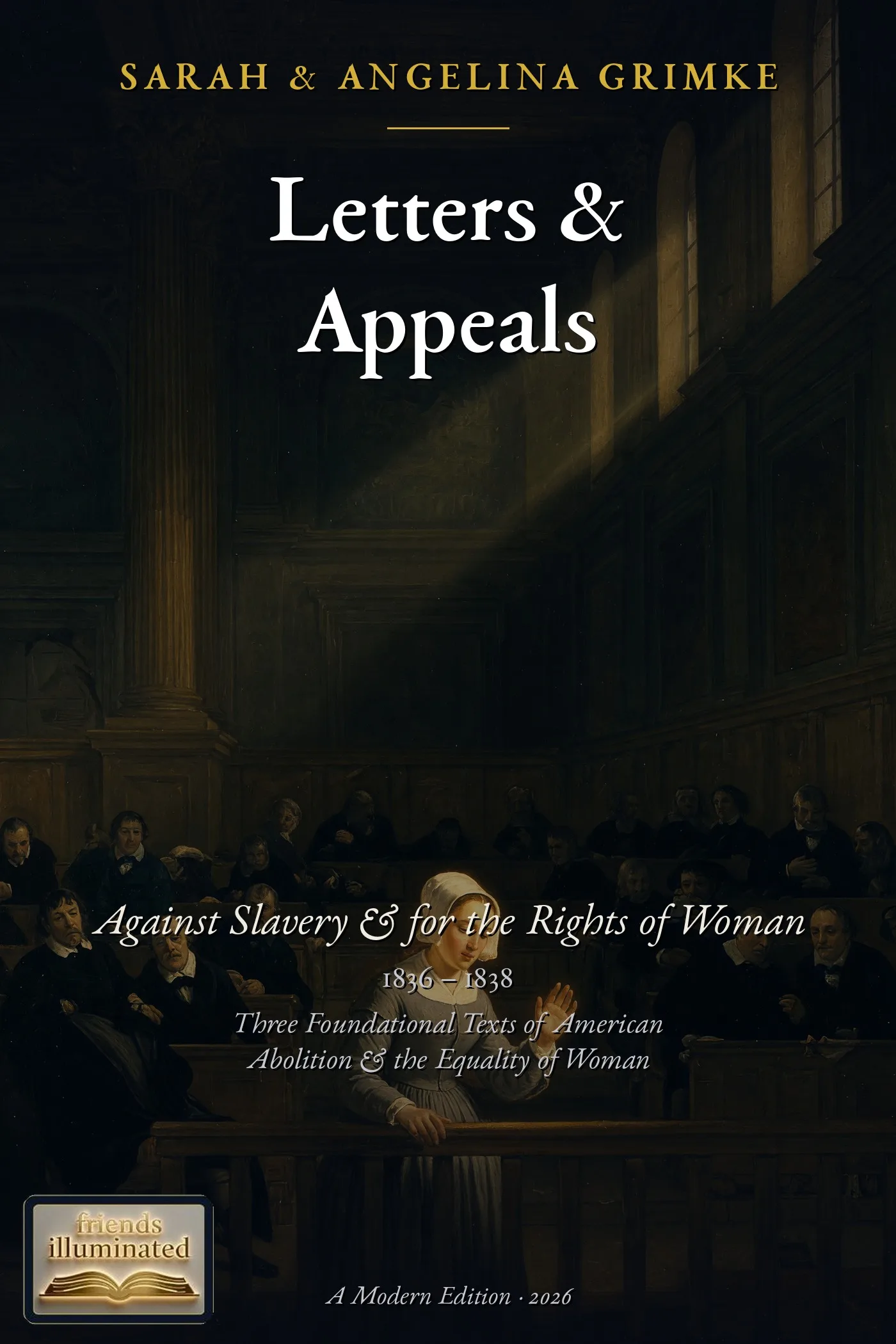
Letters & Appeals
Sarah and Angelina Grimké — daughters of a Charleston slaveholding family who became Quakers and the most electrifying abolitionist voices of their day — bound the freedom of the enslaved to the equality of women in a single testimony. This edition gathers Angelina's 'Appeal to the Christian Women of the South,' Sarah's 'Epistle to the Clergy of the Southern States,' and the full 'Letters to Catharine Beecher.' A modern English edition with linked scripture and historical references.
- Angelina Grimké's 'Appeal to the Christian Women of the South' — burned in Charleston, unanswerable in its argument
- Sarah Grimké's 'Epistle to the Clergy of the Southern States' and the complete 'Letters to Catharine Beecher'
- EPUB format
This edition
Read itE-book · EPUB
- Time to read4.8 hours
- Length68,825 words
- Files1 EPUB, DRM-free
How we get 4.8 hours
This figure is here so you can compare one book against another. Every title on the site is timed from its own word count at the same reading speed — nothing is adjusted book by book — so if this edition says 4.8 hours and another says half that, the second one really is about half the reading. It is a measure of size, in the way a page count is. Your own pace is your own: at the speeds typical adult readers actually manage, this edition runs anywhere from 3.8 hours to 6.6 hours.
What is in this edition
| Modernized text | 65,812 words |
|---|---|
| Introduction, chapter summaries and notes written for this edition | 3,013 words |
| Total | 68,825 words |
The introduction, the chapter summaries and the notes on people, places and unfamiliar terms were written for this edition. They are 3,013 of the 68,825 words above, and they are part of what you are buying.
Counted from the text of the EPUB you receive. Navigation, the title page, the table of contents and the licence page are excluded — they are packaging, not reading.
The reading rate
238 words per minute, for adult silent reading of non-fiction, applied unchanged to every title on the site. We did not pick the number; it is the pooled result of a published meta-analysis. Nothing is adjusted book by book — that consistency is what makes two of these figures worth comparing.
Brysbaert, M. (2019). How many words do we read per minute? A review and meta-analysis of reading rate. Journal of Memory and Language, 109, 104047. doi:10.1016/j.jml.2019.104047
190 studies, 18,573 participants.
The same paper puts most adult readers between 175 and
300 words per minute, and those two speeds give the
3.8 hours and 6.6 hours above.
Because time is words divided by speed, an even range of speeds produces an
uneven range of times, so 4.8 hours sits nearer the fast end of that
range than the middle of it.
If it were a paperback
Roughly 197–275 pages.
Words per printed page is a typesetting convention, not a measurement — it moves with trim size, type size and leading. The range above assumes 250–350 words a page. Friends Illuminated publishes no print edition of this book; the figure is here only because pages are a more familiar size than words.
- Secure checkout by Stripe
- Instant download
- 7-day money-back guarantee
About This Edition
Sarah (1792–1873) and Angelina (1805–1879) Grimké were born into wealth, comfort, and the daily fact of slavery. Their father was a judge and a large slaveholder in Charleston, South Carolina, and they grew up waited upon by people they were taught to call property. What set them apart was that they could not make peace with it. One after the other they left the South, left the Episcopal church of their upbringing, and became Friends in Philadelphia — and from that new ground they turned and spoke against the system that had raised them, with an authority no Northern reformer could claim.
This volume gathers the writings that made them famous and infamous. Angelina’s Appeal to the Christian Women of the South (1836) is addressed, sister to sister, to the very women among whom she had been raised, calling them to read, to pray, to speak, and to act against slavery — a book so dangerous to the slaveholding order that it was publicly burned in Charleston and its author warned never to come home. Sarah’s Epistle to the Clergy of the Southern States turns to the ministers who defended slavery from the pulpit and answers them from the same Scriptures. The Letters to Catharine Beecher — Angelina’s reply to a celebrated woman who had urged the abolitionists to be silent and the women among them to keep their place — defend at once the immediate emancipation of the enslaved and the right of women to lift their voices in public at all.
Read together, these letters and appeals show a testimony being forged in real time: the recognition that the case against slavery and the case for the equality of women were, at bottom, one case — the case for human rights. This Friends Illuminated edition presents the sisters’ texts in lightly modernized English, with the plain speech of Friends preserved where they used it, and scripture and historical references linked throughout.