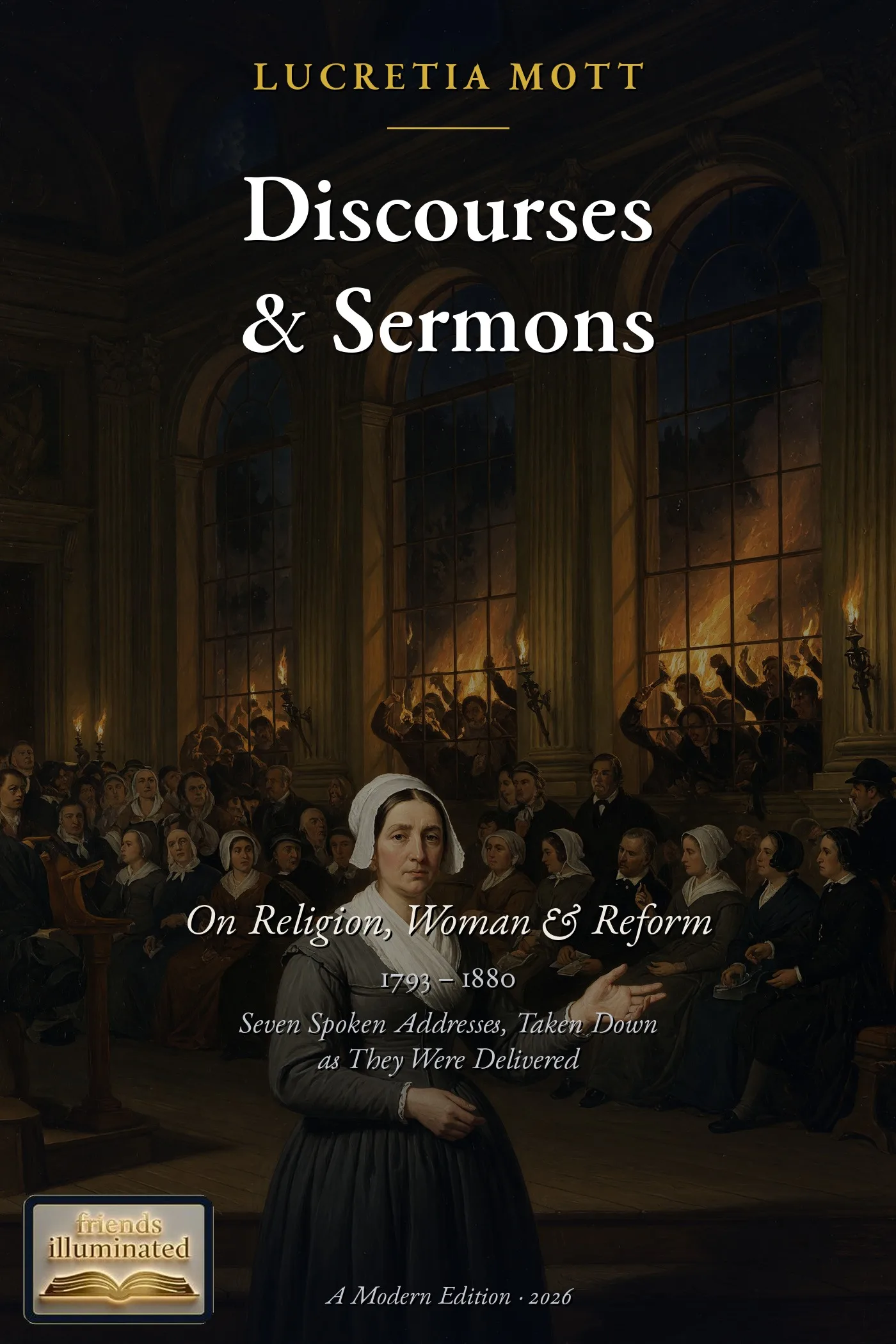
Discourses & Sermons
Lucretia Mott (1793–1880) — the Quaker minister who joined the cause of abolition with the rights of woman — in seven spoken addresses taken down as they were delivered: her autobiographical sketch, a sermon to the medical students, 'The Likeness to Christ,' 'The Abuses and the Uses of the Bible,' the celebrated 'Discourse on Woman,' 'Not Christianity, but Priestcraft,' and her remarks on John Brown before the Anti-Slavery Society. A modern English edition with linked scripture and historical references.
- Seven spoken addresses, including the famous 'Discourse on Woman'
- On religion, the uses and abuses of the Bible, abolition, and the rights of woman
- EPUB format
This edition
Read itE-book · EPUB
- Time to read1.6 hours
- Length23,315 words
- Files1 EPUB, DRM-free
How we get 1.6 hours
This figure is here so you can compare one book against another. Every title on the site is timed from its own word count at the same reading speed — nothing is adjusted book by book — so if this edition says 1.6 hours and another says half that, the second one really is about half the reading. It is a measure of size, in the way a page count is. Your own pace is your own: at the speeds typical adult readers actually manage, this edition runs anywhere from 1.3 hours to 2.2 hours.
What is in this edition
| Modernized text | 20,116 words |
|---|---|
| Introduction, chapter summaries and notes written for this edition | 3,199 words |
| Total | 23,315 words |
The introduction, the chapter summaries and the notes on people, places and unfamiliar terms were written for this edition. They are 3,199 of the 23,315 words above, and they are part of what you are buying.
Counted from the text of the EPUB you receive. Navigation, the title page, the table of contents and the licence page are excluded — they are packaging, not reading.
The reading rate
238 words per minute, for adult silent reading of non-fiction, applied unchanged to every title on the site. We did not pick the number; it is the pooled result of a published meta-analysis. Nothing is adjusted book by book — that consistency is what makes two of these figures worth comparing.
Brysbaert, M. (2019). How many words do we read per minute? A review and meta-analysis of reading rate. Journal of Memory and Language, 109, 104047. doi:10.1016/j.jml.2019.104047
190 studies, 18,573 participants.
The same paper puts most adult readers between 175 and
300 words per minute, and those two speeds give the
1.3 hours and 2.2 hours above.
Because time is words divided by speed, an even range of speeds produces an
uneven range of times, so 1.6 hours sits nearer the fast end of that
range than the middle of it.
If it were a paperback
Roughly 67–93 pages.
Words per printed page is a typesetting convention, not a measurement — it moves with trim size, type size and leading. The range above assumes 250–350 words a page. Friends Illuminated publishes no print edition of this book; the figure is here only because pages are a more familiar size than words.
- Secure checkout by Stripe
- Instant download
- 7-day money-back guarantee
About This Edition
Lucretia Coffin Mott (1793–1880) was, for half a century, one of the boldest and most beloved voices in American reform. Born on Nantucket into a plain seafaring Quaker world where women’s usefulness was simply assumed, she carried that assumption into a life that unsettled the nation: an unpaid Quaker minister who preached without notes, a founder of the Philadelphia Female Anti-Slavery Society, a leader at Seneca Falls in 1848, and a fearless advocate who faced down mobs to plead the cause of the enslaved. She spoke almost always extempore, trusting the moment; what survives of her preaching we owe chiefly to reporters who took her words down as they fell.
This Friends Illuminated edition gathers seven of those addresses. They range across the whole of her concern. In an Autobiographical Sketch she traces the roots of her convictions back to the island culture that shaped her. In a Sermon to the Medical Students she sets aside creed and controversy to press upon young men a religion of practical goodness and a living conscience against slavery. The Likeness to Christ and The Abuses and the Uses of the Bible set the living example of Jesus and the free use of conscience against the tyranny of texts and forms. Not Christianity, but Priestcraft dismantles the claim that the subjection of woman rests on divine authority. And her Remarks to the Anti-Slavery Society on John Brown show her as she called herself — “the most belligerent non-resistant.”
At the center stands the Discourse on Woman — her most famous address, delivered in reply to a lecture that would keep woman in a “narrow sphere.” Ranging from Scripture to Blackstone’s laws of coverture, Mott argues that woman’s subjection is the work not of nature or of God but of custom, miseducation, and unjust law, and calls for equal education, equal wages, open professions, and the political rights of woman: “She asks nothing as favor, but as right.” The text is presented here in lightly modernized English, with the plain speech of Friends preserved where she used it, and scripture and historical references linked throughout.