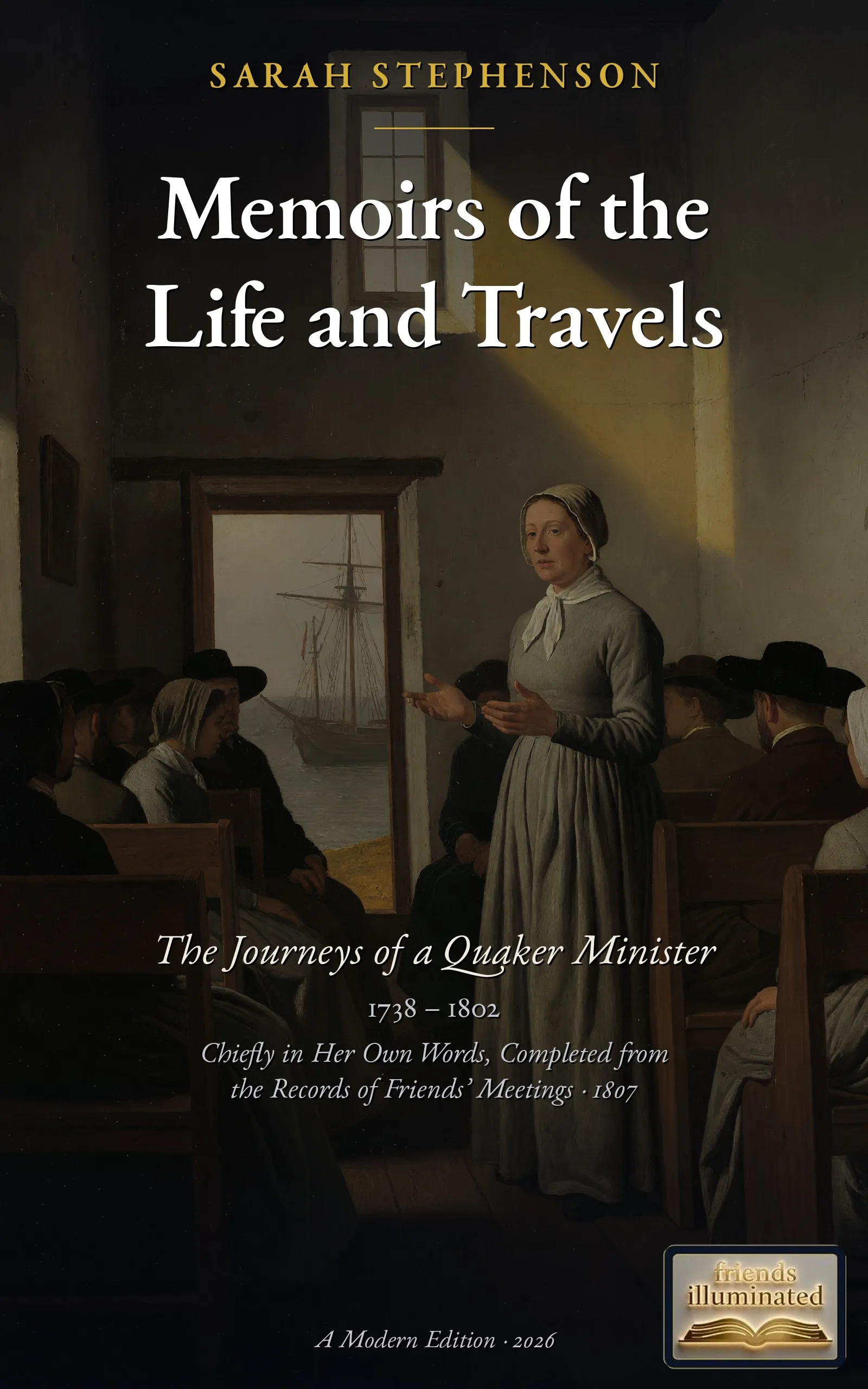
Memoirs of the Life and Travels of Sarah Stephenson
The memoirs and travel journals of Sarah Stephenson (1738–1802), a minister among Friends who crossed the Atlantic at sixty-two in broken health because she believed she was required to, and died in Philadelphia the following spring. Compiled chiefly from her own memorandums and first published at London in 1807, they follow her from a merchant's household at Whitehaven to a burial ground three thousand miles from anyone she grew up with. Modernized for present-day readers with linked scripture and historical references.
- Twenty-two chapters following thirty-five years of travelling ministry through England, Wales, Scotland, Ireland, and America
- Her own log of the 1801 Atlantic crossing aboard the Uncle Toby, and the closing scene at Philadelphia
- EPUB format
This edition
Read itE-book · EPUB
- Time to read3.4 hours
- Length48,748 words
- Files1 EPUB, DRM-free
How we get 3.4 hours
This figure is here so you can compare one book against another. Every title on the site is timed from its own word count at the same reading speed — nothing is adjusted book by book — so if this edition says 3.4 hours and another says half that, the second one really is about half the reading. It is a measure of size, in the way a page count is. Your own pace is your own: at the speeds typical adult readers actually manage, this edition runs anywhere from 2.7 hours to 4.6 hours.
What is in this edition
| Modernized text | 38,808 words |
|---|---|
| Introduction, chapter summaries and notes written for this edition | 9,940 words |
| Total | 48,748 words |
The introduction, the chapter summaries and the notes on people, places and unfamiliar terms were written for this edition. They are 9,940 of the 48,748 words above, and they are part of what you are buying.
Counted from the text of the EPUB you receive. Navigation, the title page, the table of contents and the licence page are excluded — they are packaging, not reading.
The reading rate
238 words per minute, for adult silent reading of non-fiction, applied unchanged to every title on the site. We did not pick the number; it is the pooled result of a published meta-analysis. Nothing is adjusted book by book — that consistency is what makes two of these figures worth comparing.
Brysbaert, M. (2019). How many words do we read per minute? A review and meta-analysis of reading rate. Journal of Memory and Language, 109, 104047. doi:10.1016/j.jml.2019.104047
190 studies, 18,573 participants.
The same paper puts most adult readers between 175 and
300 words per minute, and those two speeds give the
2.7 hours and 4.6 hours above.
Because time is words divided by speed, an even range of speeds produces an
uneven range of times, so 3.4 hours sits nearer the fast end of that
range than the middle of it.
If it were a paperback
Roughly 139–195 pages.
Words per printed page is a typesetting convention, not a measurement — it moves with trim size, type size and leading. The range above assumes 250–350 words a page. Friends Illuminated publishes no print edition of this book; the figure is here only because pages are a more familiar size than words.
- Secure checkout by Stripe
- Instant download
- 7-day money-back guarantee
About This Edition
Late in the winter of 1802, in a house in Philadelphia three thousand miles from anyone she had grown up with, a small, worn, sixty-three-year-old Englishwoman was asked by a Friend how she did. She said she was but poorly, and then, half pleasantly, added a question of her own: “Will you give me about six feet of ground? I don’t know but I am come to lay down my poor body among you.” She had. Two months later they buried her in the Friends’ burial ground at Philadelphia, and the last of a great many journeys was over.
Sarah Stephenson was born at Whitehaven in Cumberland in 1738, the daughter of a merchant who had gained much property and then lost it. What broke her out of what she called “the paths of vanity” was a ribbon — Elizabeth Ashbridge, visiting from America, remarked in her hearing what a pity it was that the child should have a ribbon on her head, and she came down the next morning without it. What follows in her life is a long series of these: a plain refusal made at real cost, dreaded beforehand, and paid for afterwards. She resisted the call to the ministry for two years, once getting as far as putting her hand on the seat in front of her to help herself to her feet before sitting still again, and stood up at last at Worcester in 1767 in her twenty-ninth year. For the next thirty-five years she was almost never off the road: Cumberland, Wales, Cheshire, London, Sheffield and Ackworth, five hundred miles of Scotland in a month and two days, Ireland twice, the southern counties, Norfolk, York and the border. Much of it was not preaching but the harder, quieter work of the family visit — sitting down with every household of a meeting in turn, sometimes hundreds of sittings in a single town.
The reason these memoirs outlive their century is that she does not tidy herself up. She records the concern she let a discourager talk her out of, and the fortnight of growing weight before she turned her horse around. She records a season in which her mind was led as in the valley of the shadow of death, and says plainly that unlike David she could not say she would fear no evil, because she was full of fear. In 1801, past sixty and already broken in health, she laid before her Monthly Meeting a concern she had carried in secret for years, and half hoped Friends would think her unfit and excuse her. They did not. She sailed from Pill near Bristol aboard the Uncle Toby on the eighth of the seventh month, and her own log of that crossing makes up the greater part of chapter nineteen. This Friends Illuminated edition presents the whole in twenty-two chapters with the 1807 editor’s preface intact, gently modernized for present-day readers, with her Quaker vocabulary preserved and scripture and historical references linked throughout.