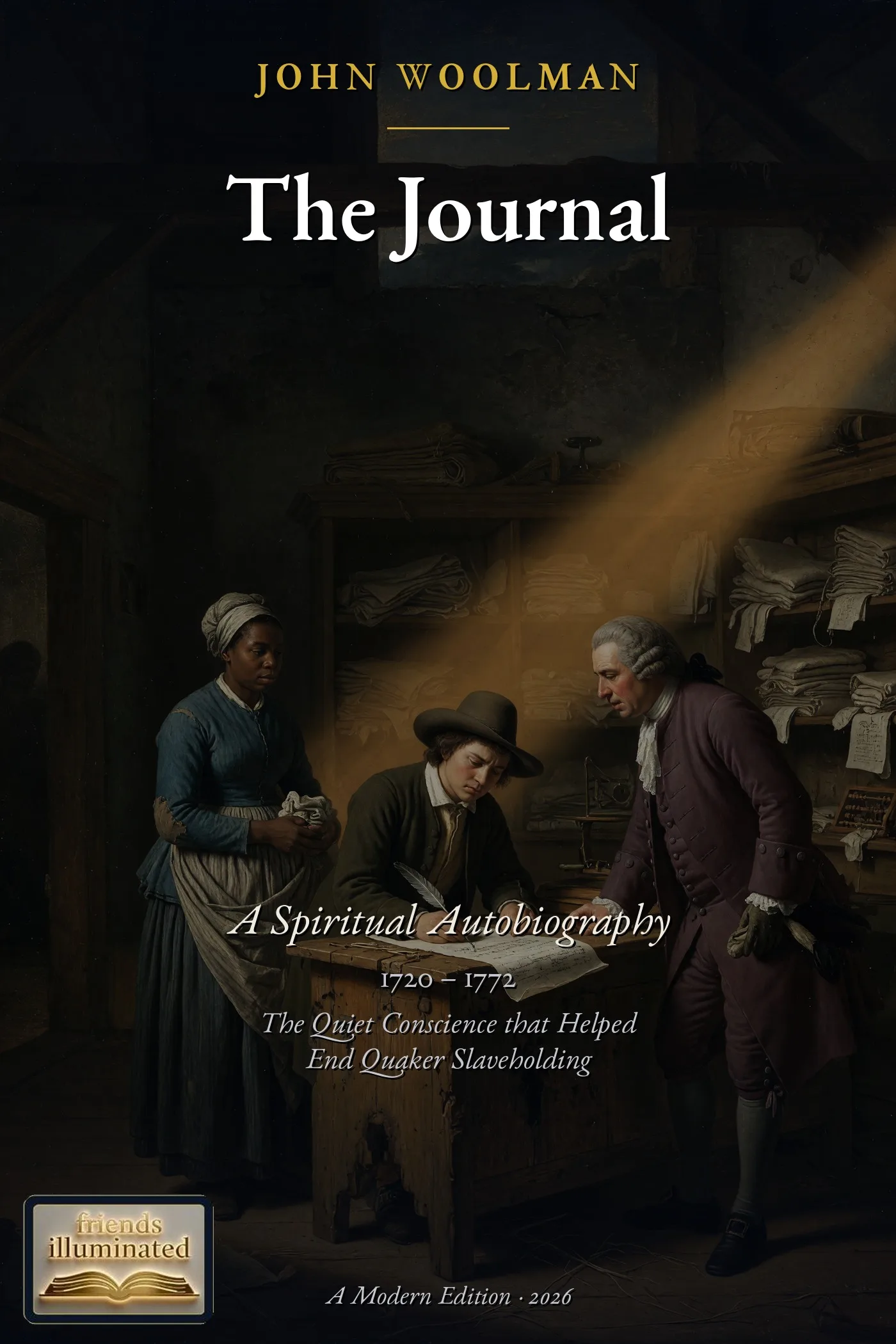
The Journal of John Woolman
The quiet revolutionary whose conscience moved a nation — Woolman's Journal is one of the most influential spiritual autobiographies in American literature, and the document that helped persuade the Quakers to become the first religious body to formally forbid slaveholding.
- Eleven chapters, about 3.8 hours
- EPUB format
- Modernized for today's reader
This edition
Read itE-book · EPUB
- Time to read3.8 hours
- Length54,164 words
- Files1 EPUB, DRM-free
How we get 3.8 hours
This figure is here so you can compare one book against another. Every title on the site is timed from its own word count at the same reading speed — nothing is adjusted book by book — so if this edition says 3.8 hours and another says half that, the second one really is about half the reading. It is a measure of size, in the way a page count is. Your own pace is your own: at the speeds typical adult readers actually manage, this edition runs anywhere from 3 hours to 5.2 hours.
What is in this edition
| Modernized text | 52,601 words |
|---|---|
| Introduction, chapter summaries and notes written for this edition | 1,563 words |
| Total | 54,164 words |
The introduction, the chapter summaries and the notes on people, places and unfamiliar terms were written for this edition. They are 1,563 of the 54,164 words above, and they are part of what you are buying.
Counted from the text of the EPUB you receive. Navigation, the title page, the table of contents and the licence page are excluded — they are packaging, not reading.
The reading rate
238 words per minute, for adult silent reading of non-fiction, applied unchanged to every title on the site. We did not pick the number; it is the pooled result of a published meta-analysis. Nothing is adjusted book by book — that consistency is what makes two of these figures worth comparing.
Brysbaert, M. (2019). How many words do we read per minute? A review and meta-analysis of reading rate. Journal of Memory and Language, 109, 104047. doi:10.1016/j.jml.2019.104047
190 studies, 18,573 participants.
The same paper puts most adult readers between 175 and
300 words per minute, and those two speeds give the
3 hours and 5.2 hours above.
Because time is words divided by speed, an even range of speeds produces an
uneven range of times, so 3.8 hours sits nearer the fast end of that
range than the middle of it.
If it were a paperback
Roughly 155–217 pages.
Words per printed page is a typesetting convention, not a measurement — it moves with trim size, type size and leading. The range above assumes 250–350 words a page. Friends Illuminated publishes no print edition of this book; the figure is here only because pages are a more familiar size than words.
- Secure checkout by Stripe
- Instant download
- 7-day money-back guarantee
About the Journal
The Journal of John Woolman is the spiritual autobiography of John Woolman (1720–1772), a New Jersey tailor, shopkeeper and Quaker minister who spent his adult life persuading Friends, one household at a time, to give up keeping slaves. He began it in the thirty-sixth year of his age and kept it up to within days of his last illness at York, England, where he died on 7 October 1772; it was first published in 1774. It covers his youth and awakening, his journeys among slaveholding Friends, his 1763 visit to the Indians on the Susquehanna, and his last voyage to England. This page offers the Friends Illuminated modernized edition ($9.99, EPUB) and a free sample from the opening chapter.
John Woolman’s Journal is widely regarded as one of the finest spiritual autobiographies in the English language. Charles Lamb called it “the only American book I ever read twice.” It was included in the Harvard Classics as essential reading, and remains continuously in print more than 250 years after its first publication in 1774.
Woolman (1720–1772) was a New Jersey shopkeeper, tailor, and itinerant Quaker minister who became one of the earliest and most persistent voices against slavery in America — not through political campaigns or fiery denunciation, but through patient, one-on-one conversations with slaveholders, always rooted in shared spiritual principles. His method changed the world: largely as a result of his decades of quiet labor, the Religious Society of Friends became the first religious body in America to formally forbid slaveholding among its members, in 1776.
But the Journal is far more than an anti-slavery tract. It is the intimate record of a man wrestling with how to live rightly in a fallen world. Woolman agonizes over whether to accept hospitality from slaveholders, whether his shop is becoming too profitable for spiritual health, whether to pay taxes that fund war, and how to speak difficult truths to people he loves. His radical commitment to simplicity — he closed his business when it grew too successful, dressed in undyed clothing, and refused to ride in stagecoaches because the horses were overworked — makes him a forerunner of modern movements for ethical consumption, animal welfare, and economic justice.
What is in the Journal
The Journal runs to eleven chapters, in Woolman’s own divisions. In outline:
- Chapter 1 — youth and first ministry. Born in Northampton, Burlington County, West Jersey, in 1720. The robin he killed as a boy; his awakening; his first words in a meeting; and the bill of sale for a woman his employer had sold, which he wrote and then spoke against on the spot.
- Chapter 2 — a trade and the first journeys. He learns tailoring so as to live on little, and in 1746 travels with Isaac Andrews through Pennsylvania, Maryland, Virginia and North Carolina.
- Chapter 3 — marriage, and the wills. He marries and settles, and when a sick man’s brother comes to have a will written that would leave slaves to the man’s children, he declines and gives his reasons.
- Chapter 4 — among slaveholding Friends. A later journey to Maryland, Virginia and North Carolina, with his conversations there and his epistle to Friends at New Garden and Cane Creek.
- Chapter 5 — the militia draft. In 1757 the Burlington County militia is drafted and soldiers are to be lodged with him; Philadelphia Yearly Meeting takes up the case of members who keep slaves.
- Chapter 6 — Chester County. Visits to Friends who kept slaves, in company with Daniel Stanton and John Scarborough, and the Yearly Meeting of 1759.
- Chapter 7 — New England. With Samuel Eastburn to Long Island, Rhode Island, Boston and Nantucket in 1760, and his distress at the slave trade at Newport.
- Chapter 8 — the Indian journey. He publishes the second part of Considerations on Keeping Negroes, and in June 1763 travels to the Indian town of Wehaloosing (Wyalusing) on the Susquehanna.
- Chapter 9 — inward exercise. Family visits and journeys from 1764 to 1769, and the restitution he made for having once, as an executor, joined in selling a boy’s time.
- Chapter 10 — the voyage. He embarks at Chester on 1 May 1772 in the steerage of the Mary and Elizabeth, and writes down what the common sailors endure.
- Chapter 11 — England and the end. He lands at London on 8 June 1772, attends the Yearly Meeting, and travels north to York, where he is taken ill of the smallpox. The chapter closes with the account kept by the Friends who nursed him. By then, as the chapter’s editorial note records, he wore undyed clothing and would not travel by stagecoach.
Why it is still read
Woolman states his reason for writing in the first sentence: “I have often felt a motion of love to leave some hints in writing of my experience of the goodness of God” (chapter 1). The same motive governs the journeys. Of his visit to the Indians he writes, “love was the first motion, and from there a concern arose to spend some time with the Indians, that I might feel and understand their life, and the Spirit they live in” (chapter 8).
He does not spare himself. Of the bill of sale he says plainly, “through weakness, I gave way, and wrote” (chapter 1). That candor, and prose that never raises its voice, are why the book has stayed in print since 1774 and was taken into the Harvard Classics in 1909.
About this edition
This Friends Illuminated edition presents Woolman’s Journal in modernized English, with eleven chapters covering his life from youth in West Jersey through his final journey to England, where he died of smallpox in York at the age of fifty-one. Includes editorial introductions, scripture links, and historical annotations.
For this book the modernizing is deliberately light. The edition’s own introduction says the text is given “substantially as Woolman left it”: his spelling, capitalization and punctuation are kept, and the Quaker names for the days and months are glossed in square brackets rather than replaced, so that Seventh-day reads “Seventh-day [Saturday]”. Each chapter opens with the summary of contents from the early printings and a short editorial note. It is faithful to the original, and readable for today.
- Length: eleven chapters with an introduction; 54,164 words, about 3.8 hours of reading.
- Format: one EPUB file, with no DRM.
- Price: $9.99, one-time, for the modernized edition.
- Free sample: the opening pages of chapter 1, from the download link in the panel above.
- The original: the public-domain text in its original form is free at Project Gutenberg. That is a different text from this paid edition.
More on the man himself is on the John Woolman author page. Two Friends who labored beside him have pages here too: Anthony Benezet and John Churchman. For where the witness went in the next century, see the Grimké sisters; for the people he belonged to, What Were the Quakers?.
Questions people ask about the Journal of John Woolman
What is the Journal of John Woolman about? It is the spiritual autobiography of a New Jersey Quaker minister. It follows him from his childhood through his journeys among slaveholding Friends, his refusal to write wills that passed slaves to heirs, his 1763 visit to the Indians at Wehaloosing on the Susquehanna, and his 1772 voyage to England, where he died at York.
When was it written and published? Woolman began it in the thirty-sixth year of his age, in the mid-1750s, and kept it up until a few days before his last illness in the autumn of 1772. It was first published after his death, in 1774.
Who was John Woolman? A Quaker minister, tailor and shopkeeper of Mount Holly, New Jersey (1720–1772). He was born in Northampton, Burlington County, West Jersey, and died of smallpox at York, England, on 7 October 1772.
Is John Woolman’s Journal in the public domain? The original text is. Woolman died in 1772 and the Journal was first printed in 1774; Project Gutenberg lists its copy as public domain in the USA. The Friends Illuminated modernized edition is a separate paid edition at $9.99, with a free sample from the opening chapter.
What is John Woolman known for? For his Journal, and for the patient, personal labor against slaveholding among Friends that it records: visiting slaveholders one household at a time, and declining to write wills that conveyed slaves. He is also known for laying down a growing business to live simply, and for crossing to England in the steerage in 1772.